
Latest
Science & Space

Hera Spacecraft Begins Survey of Asteroids Hit in NASA Deflection Test

Europe’s probe is examining Dimorphos and Didymos to learn what NASA’s 2022 impact did to the smaller asteroid.

Read the story
Science & Space · Read the story
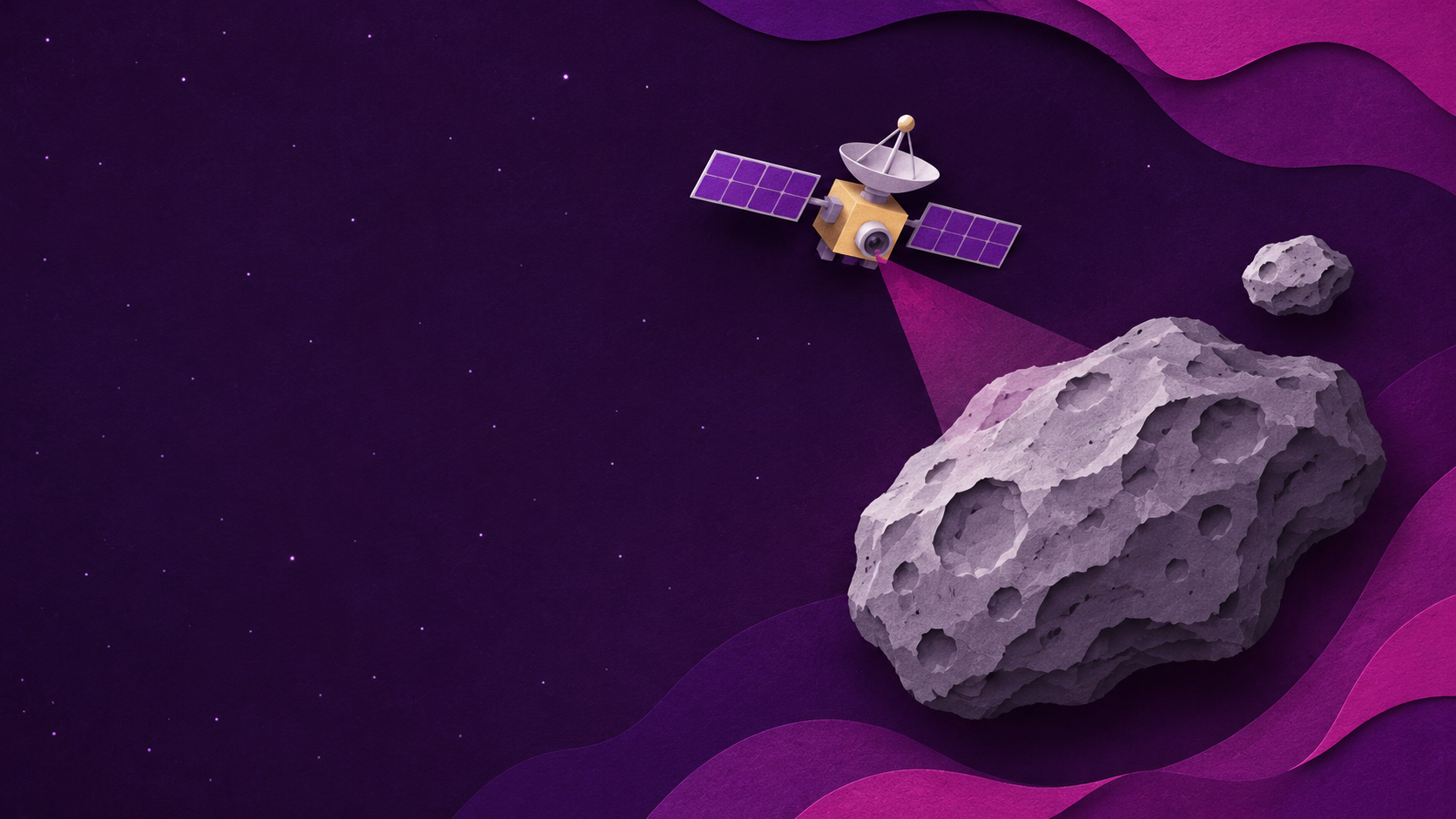
Conceptual paper-cut illustration of a spacecraft surveying a large asteroid and a smaller moonlet against purple space; not a photograph.
Conceptual editorial illustration · not an actual scene
Share this story

A follow-up to a cosmic collision

November 12, 2026, 9:48 a.m. Central time.

A European spacecraft is surveying a pair of asteroids to find out what happened after NASA deliberately struck the smaller one four years ago in a test of planetary defense.

The European Space Agency says its Hera probe has begun studying Didymos and its moonlet Dimorphos from about 25 to 30 kilometers away — roughly 15 to 19 miles. It is the opening stage of a closer investigation, not evidence of a new threat to Earth.

Why NASA hit an asteroid

In September 2022, NASA’s DART spacecraft struck Dimorphos to test whether an impact could change an asteroid’s motion. The experiment shortened the moonlet’s orbit around Didymos by about 33 minutes, ESA says.

Scientists still want to understand why the change was larger than expected and how the collision altered Dimorphos. Hera will measure the moonlet’s structure and mass and look for evidence of a crater or broader reshaping. Those details could help researchers evaluate whether a similar method might someday deflect a genuinely hazardous asteroid.

How Hera flies around the pair

Gravity around these small bodies is so weak that a conventional circular orbit is impractical, ESA says. Instead, Hera follows nearly straight legs around the pair and uses thrusters to turn, tracing a series of roughly rectangular paths.

The agency says Hera is scheduled to move closer in December. Over the coming months it plans to deploy two small companion spacecraft for additional observations and eventual landing attempts. Plans and results can change as mission controllers assess the environment.

What scientists hope to learn

Didymos is about 780 meters across and Dimorphos about 151 meters across, according to ESA. Their small size and weak gravity make close operations a challenge.

The Associated Press reports that material thrown from the impact may still be nearby. Hera’s observations are intended to test competing models of how the collision changed the asteroid, not to assume a particular outcome before measurements are complete.

Timeline

September 26, 2022: NASA’s DART struck Dimorphos. October 7, 2024: Hera launched. November 11, 2026: ESA said the probe had begun its early survey. December 2026: A closer phase is planned, subject to mission conditions.

ESA Hera mission update on X

Open the original post if the embed does not load.

Sources and visual credits

European Space Agency: Hera survey · Associated Press: Hera begins inspections · ESA Hera mission on X

Hero and thumbnail: conceptual editorial illustration, not a photograph.