Latest
Science & Space

Dinosaur Blood Clues Found in Ancient Bone—but Scientists Disagree on What They Show

Researchers report heme-related molecules and cell-like structures in a 115-million-year-old fossil. An independent expert questions whether the shapes are blood cells.

Read the story
Science & Space · Read the story
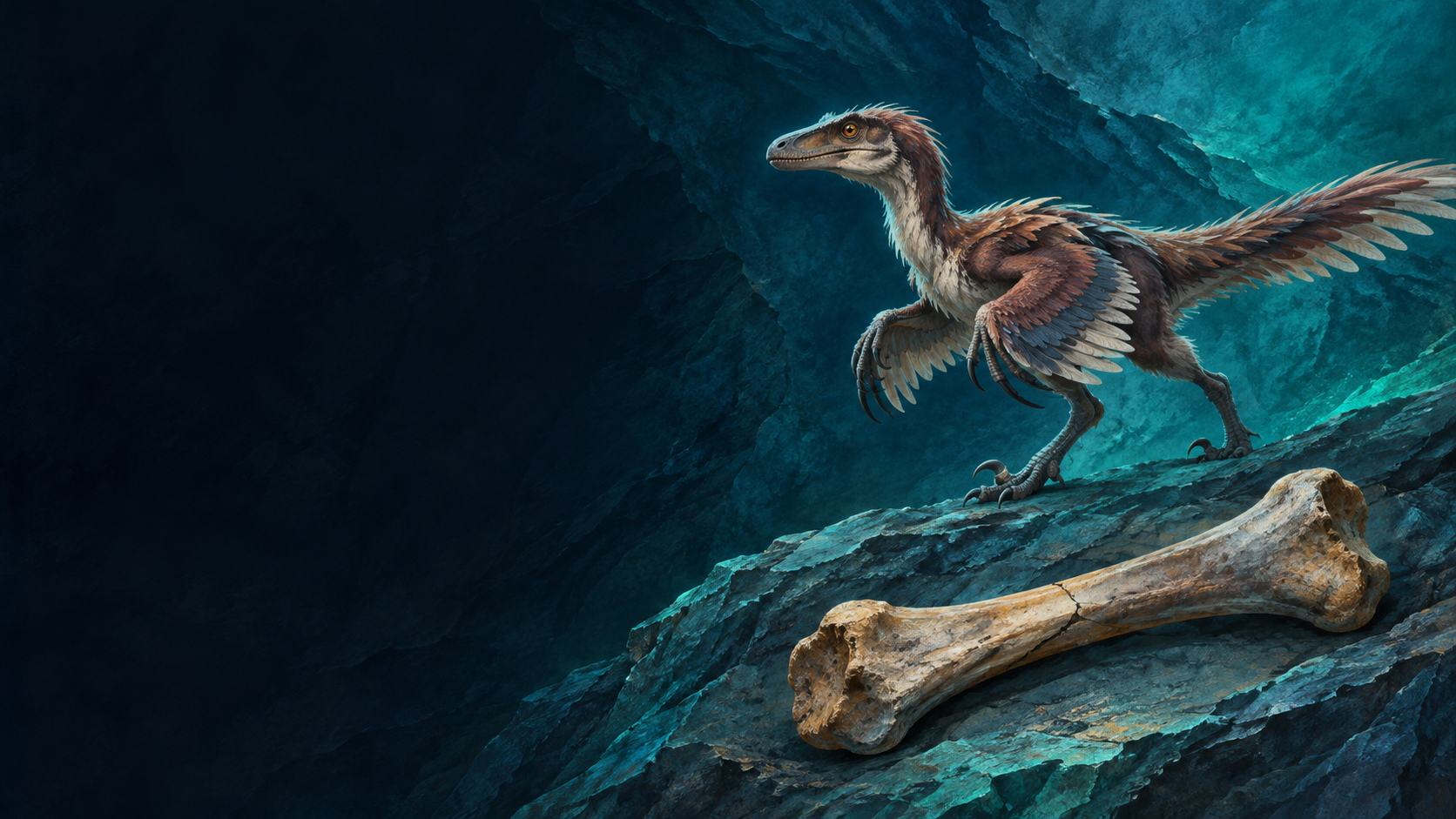
Conceptual illustration of a feathered dinosaur and a fossil bone; not the studied specimen.
Generated conceptual editorial illustration · not the actual fossil or specimen
Share this story

A tiny clue inside an ancient leg bone

November 2, 2026

Inside a dinosaur leg bone from Brazil, researchers say they found microscopic structures and chemical traces consistent with fossilized red blood cells. If their interpretation holds up, the specimen could offer a rare glimpse of biology preserved across roughly 115 million years.

The team found heme-related chemical signatures in cell-like structures within the bone’s vascular canals, according to the study’s abstract in the Proceedings of the National Academy of Sciences. Heme is a component associated with hemoglobin, the protein that helps red blood cells carry oxygen.

There is a significant caveat: independent scientists do not all agree that the structures are red blood cells. The research does not report a sample of liquid dinosaur blood or recovered dinosaur DNA.

What researchers found

The fossil belongs to Aratasaurus museunacionali, a meat-eating theropod that lived in what is now northeastern Brazil during the Cretaceous period. The specimen was unearthed in a gypsum mine in Ceará in 2008 and included parts of a hind limb, Reuters reported.

Researchers led by Curtin University geochemist Kliti Grice used chemical and imaging techniques to study the bone. In the study abstract, the team reports heme-related molecules and oval microscopic structures in channels where blood vessels once ran. It says the chemical signals in the bone differed from those in surrounding material, a comparison intended to help address possible contamination. PNAS abstract

The structures are mineralized: scientists are studying altered microscopic remains and chemical signatures, not living cells circulating in blood. The researchers also reported amino acids associated with collagen, a structural protein; that is not the same as recovering an intact ancient protein, Grice told Reuters.

Why the finding is being debated

Grice’s team interprets the combination of location, shape, mineralization and chemistry as evidence of fossilized red blood cells. The identification matters because chemical traces alone do not automatically establish what kind of structure produced them.

Mary Schweitzer, a paleontologist who was not involved in the study, told ABC Science she was not convinced by the evidence that the shapes are red blood cells, although she accepted evidence of heme and collagen-related material in the bone. Another outside researcher, Mauricio Barbi, said the structures were consistent with red blood cells but that the identification still required interpretation.

Further testing and study of other specimens may help resolve the interpretation.

What it could—and could not—tell us

Scientists once assumed soft biological material would disappear far sooner than the age of many dinosaur fossils. Researchers now investigate whether unusual conditions can preserve chemical traces or altered structures for much longer.

The team proposes that minerals and a microbe-rich burial setting may have helped preserve the material. That is an explanation under investigation, not a complete reconstruction of the animal’s final moments. The Guardian · ABC Science

And no, this finding does not provide a dinosaur genome. Grice cautioned Reuters that evidence of heme-related chemicals or cell-like shapes does not show that the much larger molecule DNA survived.

Where the fossil was found

The fossil came from Ceará state in northeastern Brazil, Reuters reported. The star marks the approximate state region, not the precise mine.

Map data: OpenStreetMap contributors, ODbL. Open map.

From fossil to research

  1. Aratasaurus lived during the Cretaceous. PNAS abstract
  2. The fossil remains were found in northeastern Brazil. ABC Science
  3. The study was published online in PNAS. PNAS

Reuters on the research

Reuters shared its report on the fossil in this X post. The study’s interpretation and the independent scientific disagreement are explained above.

Open the original post on X if the embed does not load.

Sources and visual credits

PNAS study abstract · ABC Science · Reuters · The Guardian · Reuters on X.

Hero and thumbnail: generated conceptual illustration of a dinosaur and bone; not a photograph of the specimen or a precise reconstruction of the species.