
Latest
Science & Space

Voyager 1 Recovered Contact and Is Closing In on a One-Light-Day Milestone

NASA says Voyager 1’s signal returned after an October pause as the nearly 50-year-old probe approaches a record distance from Earth.

Read the story
Science & Space · Read the story
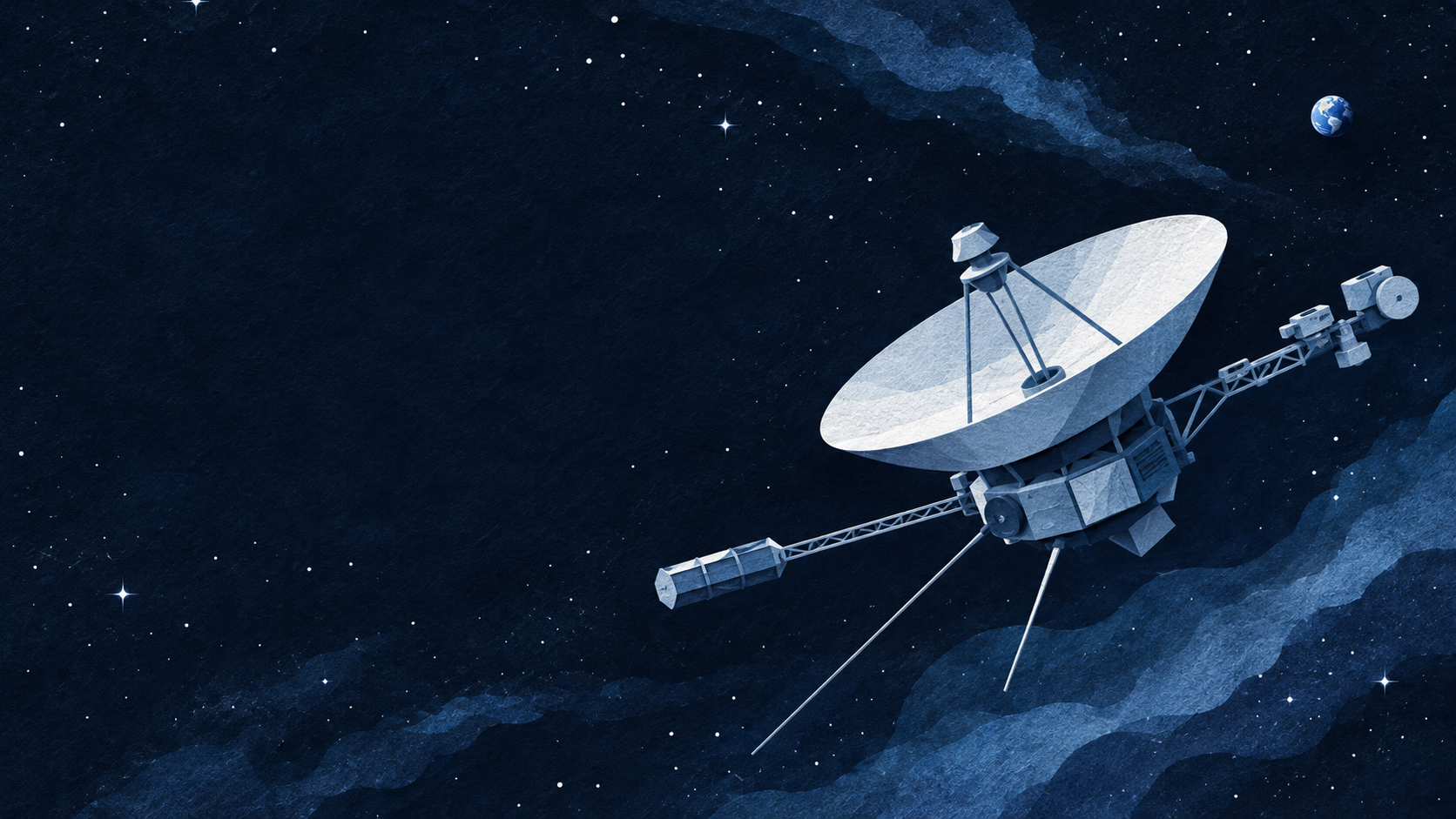
Conceptual illustration of a deep-space probe, not a photograph of Voyager 1 or its location.
Conceptual editorial illustration · not an actual scene
Share this story

A distant signal returns

November 4, 2026 · 8:45 p.m. Central

NASA’s Voyager 1 is back in contact after an unexpected pause in October, and the nearly 50-year-old spacecraft is approaching a distance no human-made object has reached: one light-day from Earth.

The agency’s Deep Space Network could not detect Voyager 1 during scheduled communications attempts on October 18 and 19. Its signal returned on October 20 before the team sent troubleshooting commands, NASA’s Jet Propulsion Laboratory said October 29.

Engineers were still investigating why contact was lost. One set of thrusters went offline and its backups activated, NASA said; the automatic change can occur when the craft detects a problem. The agency did not identify a definitive cause for the interruption.

What one light-day means

NASA expects Voyager 1 to reach the milestone on November 18 at 5:16 a.m. Eastern. One light-day is a distance: about 16.1 billion miles, or 25.9 billion kilometers, from Earth. Light and radio signals cover that distance in about 24 hours.

That delay makes a simple exchange with the probe a two-day affair: roughly one day for a command to travel outward and another for a reply to return. The spacecraft itself will not encounter a physical boundary at the marker, NASA explains.

Tom’s Hardware also reported the approaching milestone. The date is a forecast, not an event that has already occurred.

Stretching a dwindling power supply

Voyager’s radioisotope power source produces less electricity as its plutonium fuel decays. The probes lose about four watts of power a year, NASA said, forcing engineers to make choices about what stays on.

In September, the team completed an operation nicknamed the “Big Bang,” simultaneously replacing three heating-related devices with lower-power alternatives. NASA said the maneuver should allow Voyager 1’s remaining science instruments to work longer than previously expected.

Without the change, another instrument could have needed to shut down as early as summer 2027, according to JPL. The maneuver does not make the spacecraft immune to new faults.

A journey that began in 1977

Launched September 5, 1977, Voyager 1 flew past Jupiter and Saturn before continuing outward. It crossed the heliopause—the outer boundary of the bubble of particles and magnetic fields shaped by the Sun—in 2012 and now studies interstellar space.

Its twin, Voyager 2, took a different route and also visited Uranus and Neptune. NASA expects Voyager 2 to reach one light-day from Earth in November 2035.

Voyager 1 timeline

  1. — Voyager 1 launches.
  2. — The probe crosses into interstellar space.
  3. — Engineers complete the power-saving device swap.
  4. — Contact is lost and returns; the cause remains under investigation in NASA’s October 29 update.
  5. — NASA projects the one-light-day distance milestone.

Sources and visual credits

NASA JPL: power and communications update · NASA: one light-day explained · Tom’s Hardware: approaching milestone.

Visual: conceptual deep-space probe illustration, not an image of Voyager 1 or its current location.