
LATEST
SUN 4 OCT 2026
Science & SpaceSUN., OCT. 4, 2026 • VIDEO REPORT

Plague Lab Worker Dies in Siberia; Nearly 200 Under Observation

A technician at the Irkutsk Anti-Plague Research Institute has died after what one account describes as a broken test tube, Ynetnews reports. The cause of death has not been officially confirmed.

Video thumbnail: Plague Lab Worker Dies in Siberia; Nearly 200 Under Observation 3:13
189Under observation
NONEConfirmed infections
SEPT. 25Alleged lab accident

What happened

A laboratory technician at a plague research institute in Siberia has died, and nearly 200 people have been placed under observation, Ynetnews reports. Daria Shipilova, 28, died overnight between Oct. 1 and Oct. 2 at a hospital in Shelekhov, in Russia’s Irkutsk region. The cause of her death has not been officially confirmed.

According to Russian media, Shipilova worked at the Irkutsk Anti-Plague Research Institute. One account says a test tube containing the plague bacterium broke while she was working on Sept. 25. She was hospitalized on Sept. 29 with symptoms of severe pneumonia, raising suspicions of pneumonic plague.

At least 197 possible contacts were identified and 189 placed under observation, according to reports. The Shelekhov hospital was quarantined, public events in Irkutsk were canceled, and a criminal investigation was opened into suspected safety violations.

No infections have been confirmed among those under observation, and there is no evidence the disease spread.

Newstro reports facts and attributes every statement. Accounts of how Shipilova may have been infected have not been officially confirmed. All photos on this page are file photos.

The Newstro report

Read the transcript click a paragraph to jump to it in the video
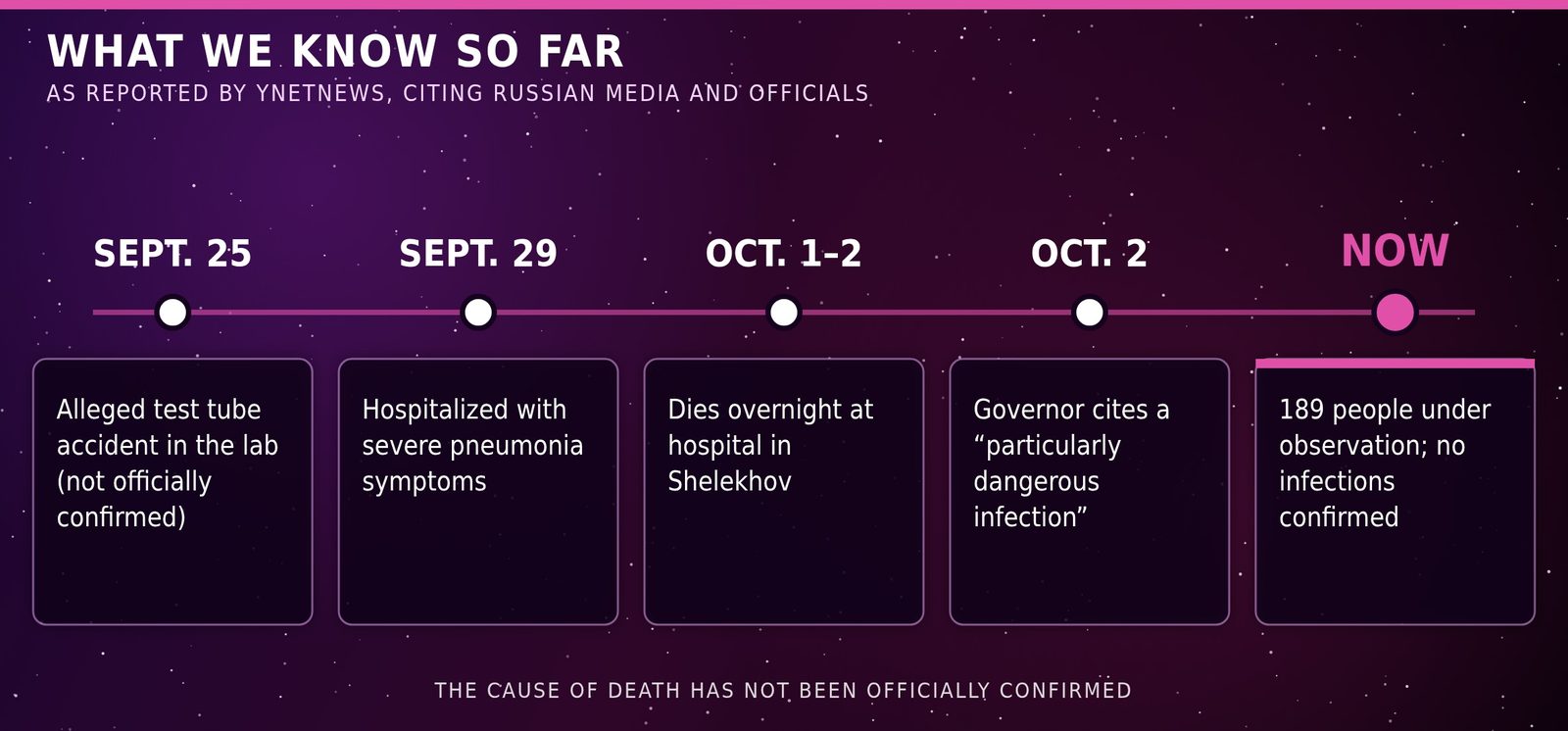
Newstro timeline: alleged test tube accident Sept. 25, hospitalized Sept. 29, died overnight Oct. 1 to 2, governor cites a particularly dangerous infection Oct. 2, 189 people under observation with no infections confirmed
GRAPHIC: NEWSTRO

What we know so far

Russia’s chief public health official, Anna Popova, traveled from Moscow for an emergency meeting, Ynetnews reports.

Irkutsk regional Governor Igor Kobzev referred only to a suspected “particularly dangerous infection,” without naming the disease, and said all contacts showed no signs of illness and had tested negative.

197Possible contacts identified
189Under observation
Newstro graphic of three unconfirmed accounts of how she may have been infected: a broken test tube, a work trip to Buryatia, or a trip to Thailand
GRAPHIC: NEWSTRO

Three accounts

Three accounts of how Shipilova may have been infected have emerged: a broken test tube, a work trip to Buryatia, or a trip to Thailand. None has been officially confirmed, and the Buryatia account was denied.

Experts disagree

Lab staff should wear protective suits, making infection from a broken tube unlikely.

Michael Favorov, epidemiologist

Questioned whether the case was plague at all.

Gennady Onishchenko, Russia’s former chief public health official

Her rapid decline is consistent with pneumonic plague, though it is not certain.

Prof. Tal Brosh Nissimov, Israeli infectious disease specialist

Paraphrased, as reported by Ynetnews.

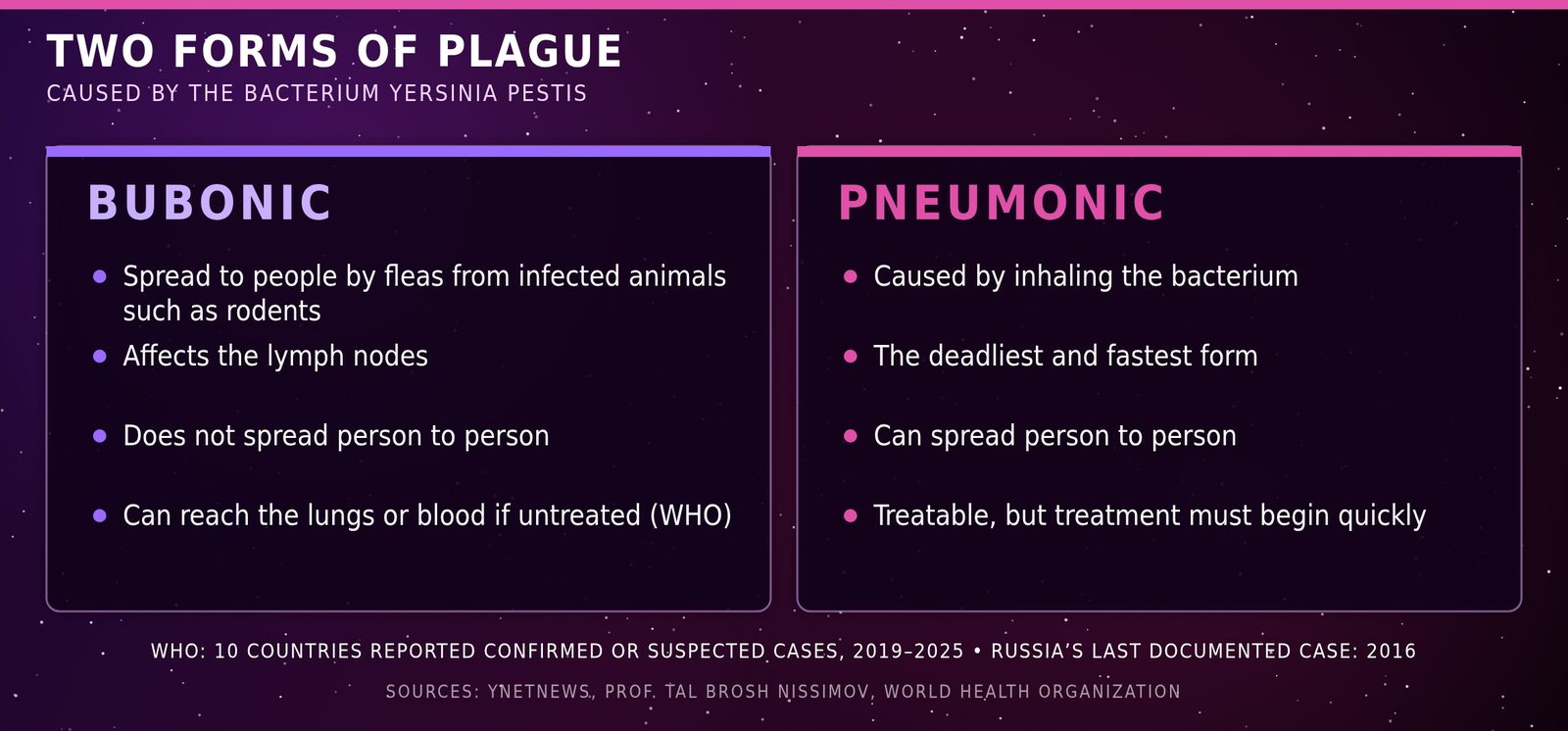
Newstro graphic comparing bubonic plague, spread by fleas and not person to person, with pneumonic plague, caused by inhaling the bacterium, the deadliest form, which can spread person to person
GRAPHIC: NEWSTRO

Two forms of plague

Plague is caused by the bacterium Yersinia pestis, behind the Black Death in the 14th century. Bubonic plague, spread to people by fleas from infected animals, does not pass from person to person.

Pneumonic plague, caused by inhaling the bacterium, is the deadliest form and can spread between people. It can be treated, but treatment must begin very quickly, Brosh Nissimov said.

~4,000Suspected cases, 2019–2025 (WHO)
2016Russia’s last documented case

Sources and credits

Reporting

Ynetnews — “Mystery in Siberia: anti-plague lab worker dies after test tube breaks, nearly 200 isolated” (Oct. 4, 2026). World Health Organization figures as cited by Ynetnews.

Images

  • All graphics on this page — Newstro, based on Ynetnews reporting

The video uses file photos from Wikimedia Commons: a Yersinia pestis micrograph (Rocky Mountain Laboratories / NIAID / NIH, public domain), Irkutsk (Vyacheslav Argenberg, CC BY 4.0), Shelekhov (Artyom Poloz, CC BY-SA 3.0), the Rospotrebnadzor anti-plague center building in Moscow (Gennady Grachev, CC BY 2.0), laboratory test tubes (Sarka Na kopci, CC BY-SA 4.0), a biosafety suit (CDC / Brian W.J. Mahy, public domain) and a marmot (Alastair Rae, CC BY-SA 3.0).