
A clue in tiny grains
November 19, 2026, 01:53 UTC.
A dozen grains of dust collected high above Earth are giving scientists a glimpse of ancient water that may once have existed beyond Neptune.
Researchers at NASA and UCLA say the particles contain chemical signatures consistent with a long-predicted reservoir of water ice in the Kuiper Belt, the distant region of icy objects at the edge of our planetary neighborhood. The finding is evidence inferred from dust, not a direct observation of an intact reservoir.
A NASA high-altitude aircraft collected the tiny grains in Earth’s stratosphere. Scientists then examined their minerals and oxygen isotopes—different forms of the same element—to look for traces of past interactions between water and rock, according to NASA and UCLA.
What the dust can—and cannot—tell us
The team argues that damage tracks left by energetic particles from the sun support a long journey from the outer solar system. The chemical evidence points to ancient water relatively enriched in heavier oxygen isotopes, researchers say.
The grains’ precise parent bodies are unknown. Both their Kuiper Belt origin and the composition of the ancient water are interpretations of the evidence, and the sample is small. The water itself was not measured directly, Phys.org reported.
The work offers a way to investigate material from a region that spacecraft rarely visit. Researchers have proposed that the growing giant planets may have helped keep distinct stores of water separated early in the solar system’s history; that explanation remains a hypothesis.
Sources and visual credits
Reporting: NASA; UCLA; Study abstract; Phys.org.
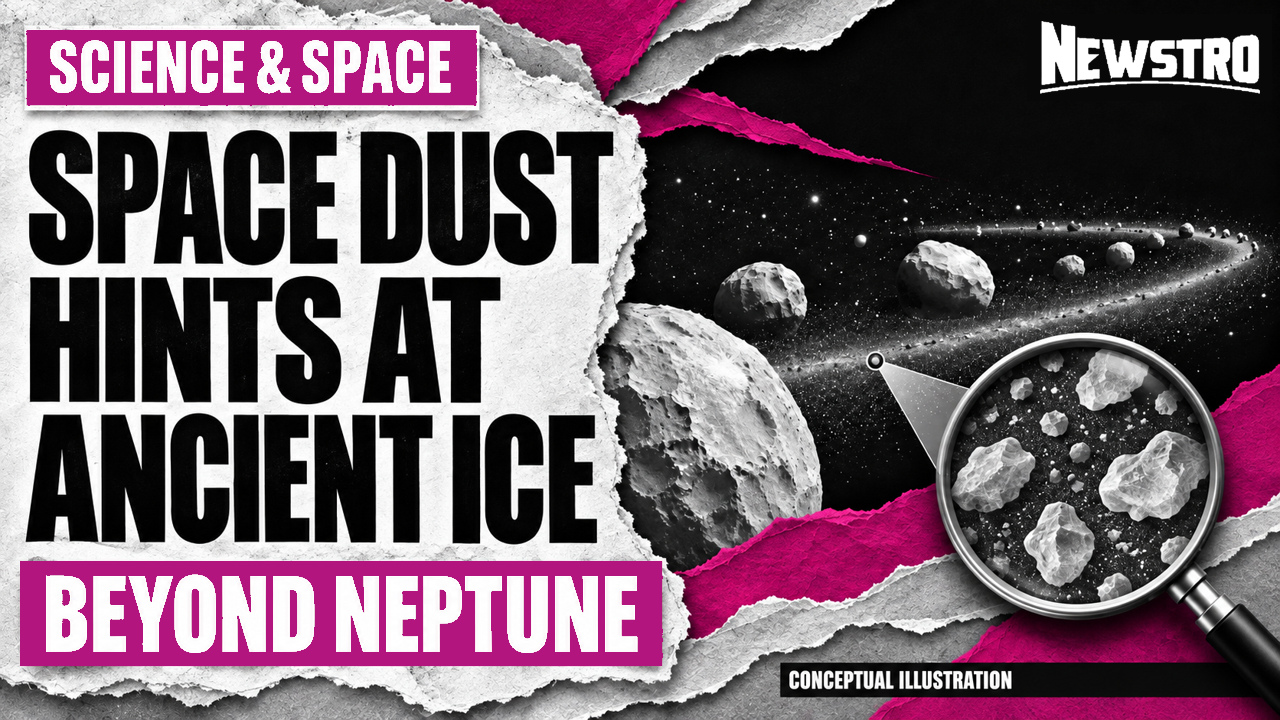
Visual: Conceptual editorial illustration; not a photograph of the event.