

Latest
Science & Space

Tiny Radio Tags Are Helping Scientists Follow Monarch Butterflies South

Lightweight transmitters and a network of receivers are revealing parts of individual monarch migrations.

Read the story
Science & Space · Read the story
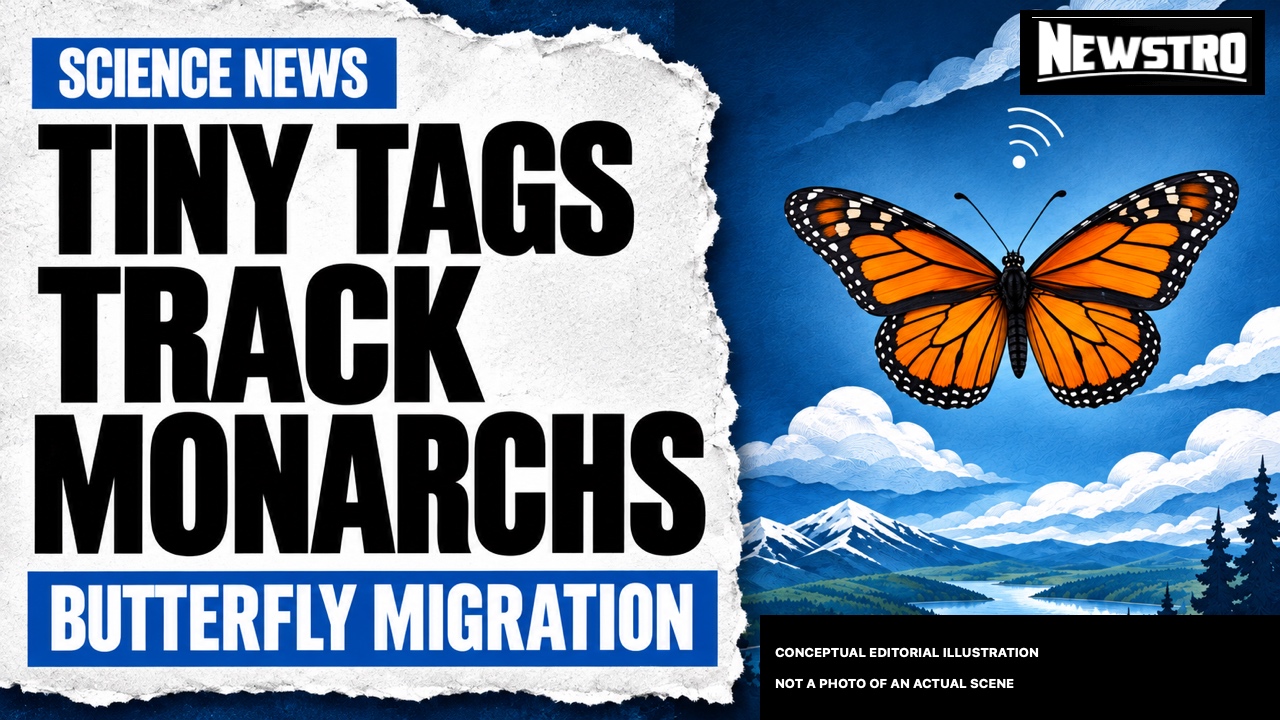
Conceptual monarch butterfly and landscape; not an actual tagged animal or migration photograph.
Conceptual editorial illustration · not an actual scene
Share this story

Following an individual butterfly

November 4, 2026 · 7:31 a.m. Central

Researchers are using tiny radio transmitters to follow individual monarch butterflies on their autumn migration, gathering clues about the routes and stopping places that carry them toward winter habitat in Mexico.

The U.S. Fish and Wildlife Service says this season’s solar-powered Bluetooth tags weigh about six milligrams. Phones and other receiving devices can detect a tag when it passes within range, giving researchers a record of that encounter.

The Associated Press reports that scientists from the United States, Canada and Mexico are collaborating on the project. The resulting observations can show parts of a journey that were difficult to reconstruct from a butterfly found only at its starting point and destination.

How the tracking works

Researchers attach lightweight transmitters to selected butterflies. The tags send a signal that nearby phones or compatible receivers can pick up; the detections are then collected for researchers to study. They are not continuous GPS tracks, and a missing detection does not by itself show where a butterfly went.

Fish and Wildlife says one tracked monarch released in northeastern Utah on September 2 was detected on October 11 in Santa Catarina, Nuevo León, Mexico. Another tagged in Minnesota was last detected in the Big Bend area of Texas, near the Mexican border, in the agency’s October update.

The agency says people can follow individual butterflies through the Project Monarch app. The records depend on the receiving network and the tags available for the study; they do not represent every migrating monarch.

Why the journey matters

Eastern North American monarchs travel south to overwintering forests in central Mexico. Some journeys cover thousands of miles, according to AP, linking breeding areas, feeding stops and winter habitat across borders.

Researchers hope the expanding data can help them examine migration routes, survival and roosting sites. Fish and Wildlife says partners in Canada, Mexico and the United States are also working to share data and standardize research methods. Tracking alone does not establish why a particular butterfly survives or how the entire population is changing.

Where monarchs spend winter

The star marks the approximate central Mexican mountain region containing monarch overwintering habitat. Migration spans a much wider area, and the marker is not the location of a particular butterfly.

★ Approximate central Mexican overwintering region. Map data: OpenStreetMap contributors, ODbL. Open map.

Tracking milestones

  1. — Project Monarch recorded migrating butterflies using the new tracking technology, according to Fish and Wildlife.
  2. — A tagged monarch began its recorded migration in northeastern Utah.
  3. — That monarch was detected in Nuevo León, Mexico, the agency said.
  4. — Fish and Wildlife published an update on the research.

Sources and visual credits

U.S. Fish and Wildlife Service: tracking project · Associated Press: monarch migration and researchers · Journey North: migration observations.

Visual: conceptual monarch and migration illustration, not a photograph or a depiction of an actual tagged butterfly. Map data: OpenStreetMap contributors, ODbL.