Latest
Election

Judge Dismisses DOJ Challenge to Alaska Senate Ballots; Department Appeals

A federal judge rejected the effort to delay certification and examine ballots cast for a second Dan Sullivan; the Justice Department has appealed.

Read the story
Election · Read the story
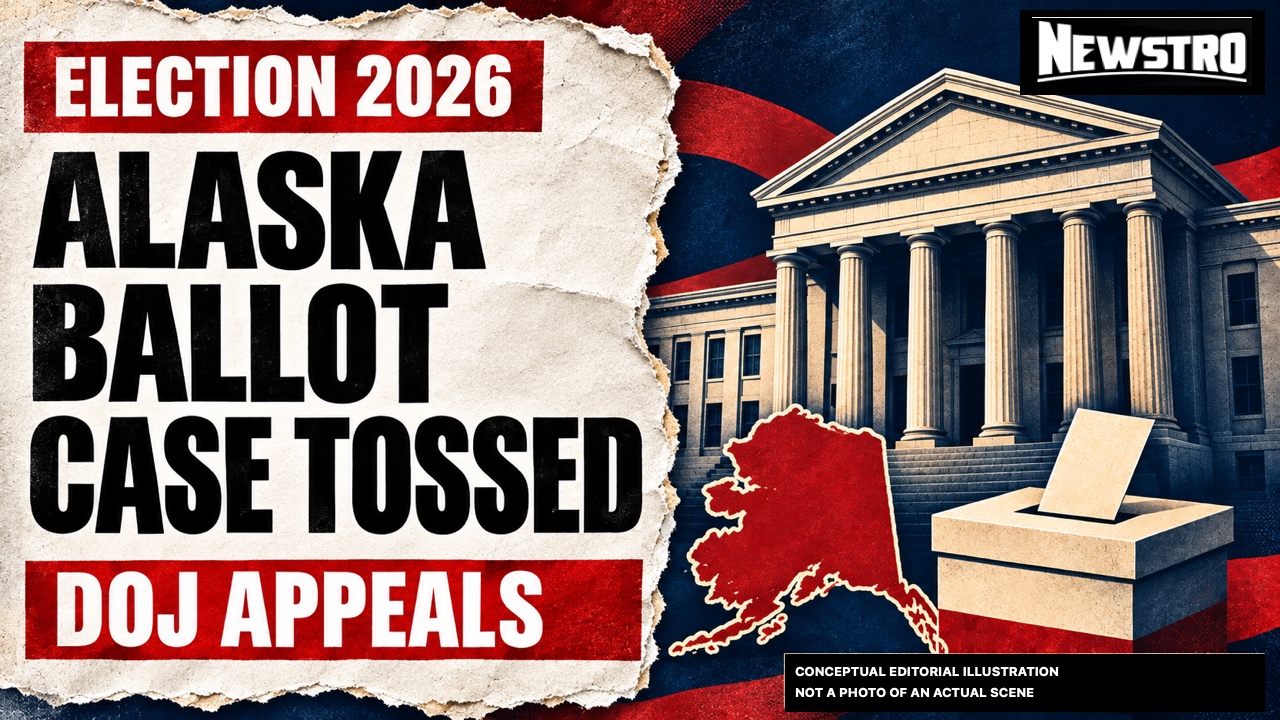
Conceptual illustration of a courthouse, Alaska and a ballot box, with headline about the dismissal and appeal.
Conceptual editorial illustration · Newstro
Share this story

Judge dismisses lawsuit as election approaches

A federal judge has dismissed the Justice Department’s lawsuit seeking to delay certification of Alaska’s U.S. Senate election under certain circumstances, a case driven by the presence of two candidates named Sullivan on the ballot. The department has appealed.

U.S. District Judge Sharon Gleason issued her order on November 1, two days before the general election. The federal government wanted a possible inquiry into ballots cast for Daniel J. Sullivan Jr., a different candidate from Republican incumbent Sen. Dan S. Sullivan. Democrat Mary Peltola is also running.

Gleason ruled that the department had not established standing because its requested relief would not remedy the alleged harm. The Associated Press reported that the Justice Department filed a notice of appeal shortly afterward. The notice challenges the dismissal; it is not itself a reversal of the ruling.

The department alleged voters might confuse the two candidates. The allegation does not establish that a particular ballot was mistaken or that the race’s result will be affected.

Originally published October 31, 2026. Updated November 2, 2026, at 9:22 p.m. Central, to report the dismissal and appeal. Court proceedings may change; consult the Alaska Division of Elections for official voting information.

Why the judge dismissed the case

Gleason found that the department had not identified a workable way to examine the intent of voters who chose Daniel J. Sullivan Jr. while protecting the secret ballot. She also wrote that the requested intervention concerned matters for which the state, rather than the federal executive branch, bears responsibility. Her ruling noted the caution courts exercise before changing election rules close to an election.

The decision addressed whether the federal government had standing to obtain its requested relief; it did not determine the election’s outcome or settle the disputed recruitment allegations. DOJ said voters deserve a fair election and appealed, according to the AP.

Which Sullivan is which?

Dan S. Sullivan is Alaska’s incumbent U.S. senator, a Republican seeking another term. Daniel J. Sullivan Jr. is a retired teacher from Petersburg who is also on the Senate ballot; he is not the incumbent.

The ballot identifies the senator by his middle initial and as the Republican incumbent. The other Sullivan is identified by his full first name, middle initial and “Jr.,” without a party designation, according to the Associated Press. State candidate listings and reporting have described the challenger’s registration at different points; the ballot’s own wording is the relevant distinction for voters.

Peltola, a former U.S. representative, and Gerald L. Heikes are also on the general-election ballot. Alaska’s candidate list and sample-ballot page provide official information.

What the Justice Department sought

The department sued Alaska and election officials on October 22. Its original complaint argues that the similar names could lead voters intending to support the senator to choose his namesake. It sought to prevent certification of a result potentially affected by that alleged confusion pending an investigation, under conditions described in the complaint.

In the later filing, federal lawyers asked the court to require preservation and separation of ballots that rank Daniel J. Sullivan Jr. so investigators could examine possible confusion if an inquiry became necessary. They also sought expedited discovery concerning alleged recruitment of the candidate. President Donald Trump has said he directed the department to bring the case, the AP reported.

The department’s theory is contested. It does not establish that voters were confused, that a particular ballot was cast by mistake, or that the election result will be affected. Election Day has not yet arrived, and the result is not known.

Alaska officials push back

Attorneys for the state say the lawsuit has no legal basis and that election officials have already taken steps to distinguish the candidates. In response to the separation request, they questioned how workers could isolate the ballots without compromising ballot secrecy and said a separated ballot would not reveal why a person ranked a candidate, according to the AP.

Peltola’s campaign, the Democratic Senatorial Campaign Committee and voting-rights groups also sought dismissal. Gleason dismissed the lawsuit on November 1; the Justice Department has appealed.

Alaska’s election division initially disqualified Daniel J. Sullivan Jr. from the primary ballot in June, citing concerns about confusion. A state superior court reversed that decision, and the Alaska Supreme Court affirmed that he could appear, FactCheck.org reported. The current federal lawsuit concerns certification and preservation of ballots, a separate question from that earlier ballot-access ruling.


The recruitment allegation—and the denials

The New York Times reported that people aligned with Peltola’s campaign had pursued an effort to recruit candidates, including another Dan Sullivan, to draw support from the incumbent. The Justice Department cited that reporting in its filing. The allegation remains disputed.

Peltola has denied knowing about an effort to put the other Sullivan on the ballot; her campaign and national Democratic Senate officials have denied involvement in a scheme. Daniel J. Sullivan Jr. has denied running at Democrats’ behest. NBC News reported that Peltola’s former campaign manager, a source in the Times investigation, later retracted her statements to the newspaper; the Times account also described other material it had reviewed.

Alaska’s U.S. attorney confirmed a separate criminal investigation, the AP reported, but did not identify potential charges or investigation targets. An investigation is not a finding of wrongdoing.

How Alaska’s ranked-choice ballot works

Voters may rank candidates in order of preference and may rank as many or as few as they choose, according to the Alaska Division of Elections. If no candidate wins a majority in the first count, the lowest-ranked candidate is eliminated and affected ballots can transfer to the next remaining choice. Counting continues under the state’s rules.

The state advises filling in no more than one oval for each candidate or each ranking column. Voters who make a mistake can ask for a replacement ballot. For individual voting questions, polling locations and current instructions, consult the state elections office.

Where the case is being heard

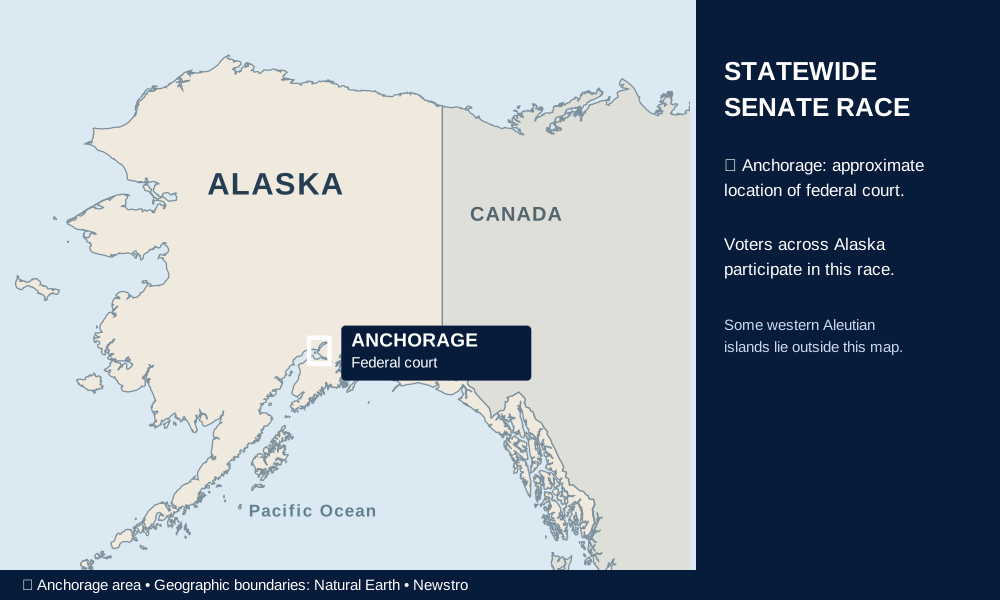
The Senate election is statewide. The federal case is in the U.S. District Court for Alaska; the star marks the approximate Anchorage area, not a polling place or a location where any particular ballot was cast.

Map of Alaska and western Canada with a star marking the approximate Anchorage area, where the federal case is being heard. The Senate election is statewide; some western Aleutian islands are outside the map.
★ Approximate Anchorage area · Statewide Senate race · Map boundaries: Natural Earth, public domain · Court location: federal filing · Newstro

Timeline

Dates follow Alaska local time; exact times are omitted.

  1. Alaska’s election division disqualifies Daniel J. Sullivan Jr. from the primary ballot; he appeals. Source: FactCheck.org
  2. A superior court restores his ballot access, and the Alaska Supreme Court affirms that decision. Source: federal court order
  3. Alaska holds its open primary. Peltola and both Sullivans advance toward the general election. Source: FactCheck.org
  4. The Justice Department files its federal certification lawsuit. Source: complaint
  5. The Times reports allegations about recruitment; Peltola denies knowledge. Federal lawyers ask to preserve and separate ballots, and Alaska officials object. NBC News · AP
  6. Gleason dismisses the case; the Justice Department files a notice of appeal. Court order · Notice of appeal
  7. Alaska’s general election is scheduled. Source: Alaska Division of Elections

What happens next

The Justice Department has appealed the dismissal. The notice of appeal does not itself decide the appeal, and the election is scheduled for November 3.

The outcome of the election, any effect of the similar names, and the result of the criminal investigation remain unknown. For voters, the names and ballot instructions are available from Alaska’s elections office—not from the competing claims in the lawsuit.

Sources and visual credits

U.S. District Court: dismissal order · Justice Department: notice of appeal · Associated Press: ruling and appeal.

The Hill: supplied article · The Hill via AOL: related report · Justice Department motion · Associated Press: federal request and state response · Alaska Division of Elections: ranked-choice voting.

Correction, November 2, 2026: An earlier timeline gave June 27 as the date the superior court restored Daniel J. Sullivan Jr.’s ballot access. The federal court order dates that decision to June 26; the Alaska Supreme Court affirmed it on June 29.

Earlier thumbnail: archive portraits of Mary Peltola (U.S. House, 2022) and incumbent Sen. Dan S. Sullivan (U.S. Senate, 2015), public domain, cropped for this composite. Daniel J. Sullivan Jr. is not pictured. Current hero and thumbnail: generated conceptual editorial illustration; neither depicts an actual courthouse or ballot. Map boundaries: Natural Earth, public domain.