The latest
November 8, 2026.
The Federal Aviation Administration (FAA) and international safety authorities have launched an inquiry into a hazardous loss of separation at Los Angeles International Airport after an Air France widebody jet executed an unauthorized left turn immediately following takeoff, cutting across a parallel departure corridor and nearly colliding with an American Airlines passenger plane.
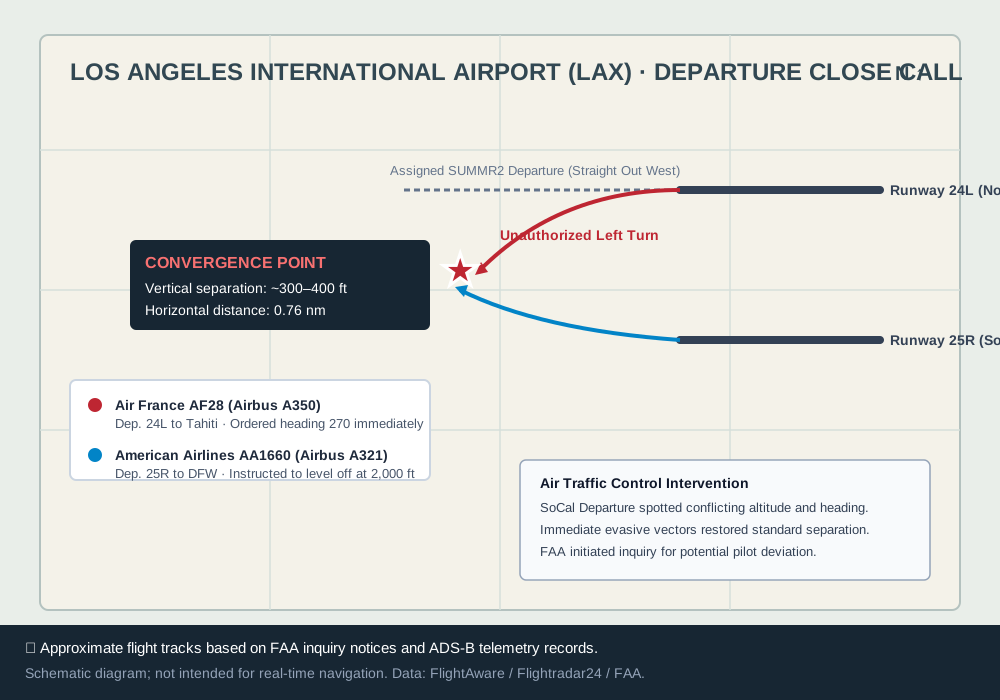
The incident occurred in the early hours of Saturday, November 7, when Air France Flight AF28—an Airbus A350-900 bound for Papeete, French Polynesia—lifted off from Runway 24L on LAX's northern airfield complex. Instead of adhering to its assigned straight-out Standard Instrument Departure (SID) over Santa Monica Bay, the long-haul airliner veered south toward the departure path of American Airlines Flight AA1660, an Airbus A321 departing parallel Runway 25R for Dallas–Fort Worth.
Rapid emergency intervention by a SoCal Terminal Radar Approach Control (TRACON) controller averted catastrophe. Telemetry data confirmed that the two commercial airliners converged to within approximately 300 to 400 feet vertically and just 0.76 nautical miles horizontally before controllers restored adequate clearance.
Parallel takeoffs and an unauthorized turn
Los Angeles International Airport operates four parallel runways split into two distinct complexes: the north complex (Runways 24L and 24R) and the south complex (Runways 25L and 25R). Because outbound flights routinely climb west simultaneously over the coastline, strict instrument departure protocols require aircraft departing the north complex to maintain runway heading until reaching designated offshore waypoints.
Flight AF28 had been assigned the standard SUMMR2 departure. However, immediately after becoming airborne, the Air France flight crew initiated an unassigned left banking turn directly into the southern airspace sector. At that moment, American Airlines Flight AA1660 was climbing out through 1,800 feet on its scheduled departure track.
The unexpected course deviation generated an urgent automated conflict alert on air traffic control radar displays, warning that the two twin-engine jets were on a closing trajectory with closing speeds exceeding 350 knots.
Urgent controller commands and pilot deviation inquiry
Radio transmissions archived by LiveATC.net capture the high-stakes commands issued by the departure controller, who ordered the Air France crew to immediately reverse their turn and instructed the American Airlines crew to halt their climb.
"Air France 28, fly heading 270 immediately! Maintain 270," the controller directed over the frequency, ordering the widebody back toward an open oceanic vector. Seconds earlier, the controller instructed American Airlines 1660 to level off at 2,000 feet to establish minimum vertical separation beneath the descending French jet.
When the controller questioned why Flight AF28 had departed its assigned departure path, the cockpit crew responded with "Standby." Upon transferring to en route airspace, the crew was instructed to copy a Brasher notification—a telephone number given when an aircraft may have committed a pilot deviation—triggering a formal FAA investigation. Both aircraft completed their flights safely without reported injuries or damage.
Aviation safety report
Aviation monitoring group AIRLIVE shared radar tracking captures and details of the close call on X:
View the radar track and report on X if the post does not render.